I used to hire freelancers. Good ones, on reasonable rates, several of them for years. Then the work started turning up with a particular smell to it, and after the third or fourth time I stopped wondering and started checking.
It was raw Gemini output. Not adapted, not edited, in one case not even reformatted from the chat window it came out of. Another writer was sending plain ChatGPT with the em dashes still in. Neither had mentioned it, and I hadn't thought to ask, because it hadn't occurred to me yet.
So here's the argument, and it isn't the one people expect from somebody who sells AI content systems. Freelance writers vs AI is a choice that no longer exists. The freelancers are using AI. The only question left is whether anyone is using it well.
The gap this article is about
Industry figures, taken from independent write-ups published in 2026 that agree with one another, checked on 11 August 2026. Treat them as market shape rather than precision. The first two are the ones that matter, and the distance between them is the subject of this piece.
Two different populations, measured separately, which is why they are labelled rather than stacked. Nearly everybody buying is asking for something a majority of the people selling can no longer honestly supply. Industry figures for 2025 to 2026, checked 11 August 2026.
Read Those First Two Numbers Together
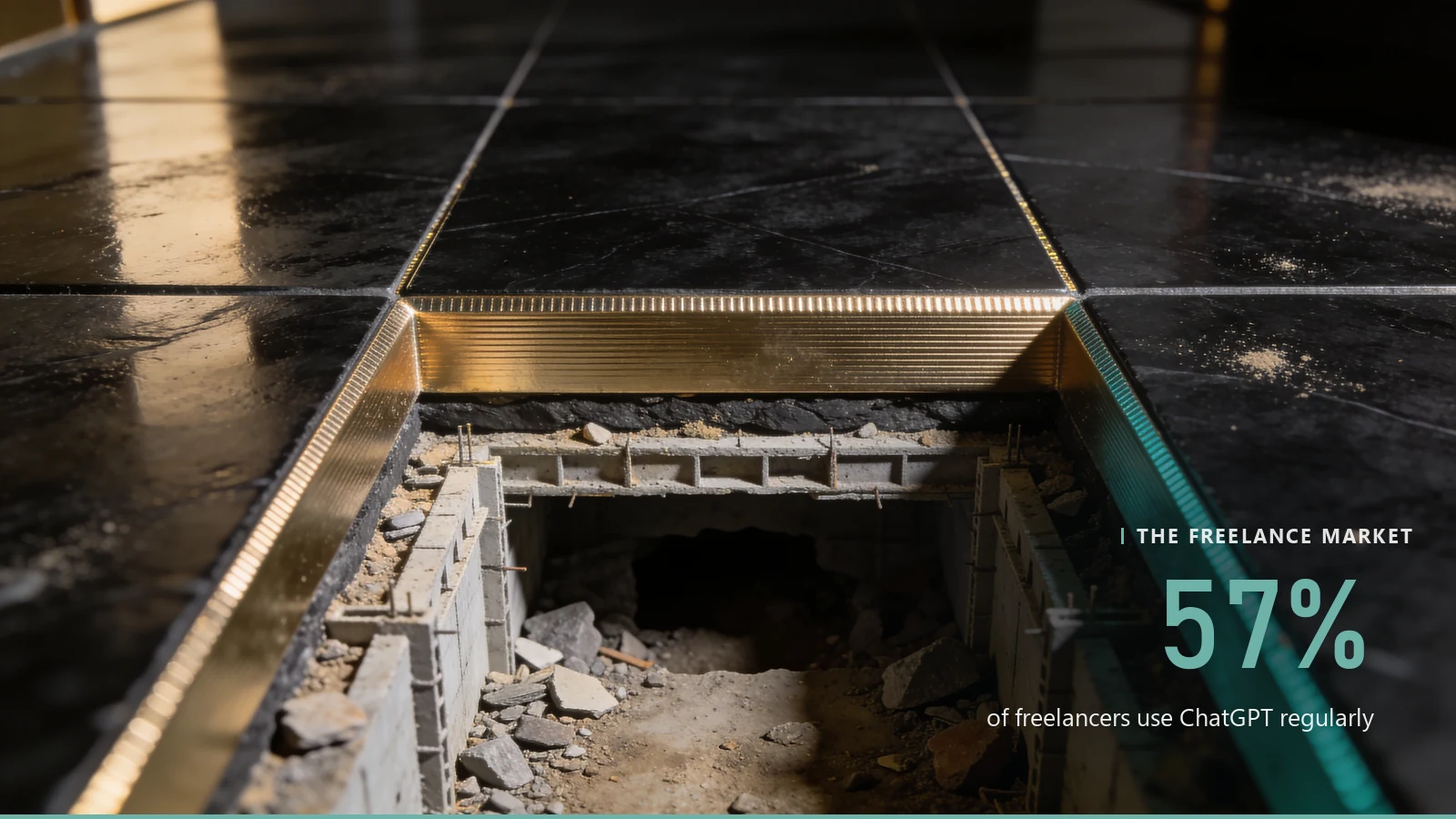
Ninety-five per cent of clients are asking for proof of human authorship. Fifty-seven per cent of freelancers use ChatGPT regularly. Those two figures can't describe the same transactions unless a lot of people are answering that question loosely.
That gap isn't a scandal and I'm not presenting it as one. It's what happens when a market asks a question nobody can verify the answer to and attaches no consequence to getting it wrong. Everybody asserts, nobody checks, and the assertion turns into a formality.
You are not choosing between a human and a machine. You are choosing between AI somebody governs and AI nobody does.
Why Freelance Writers vs AI Is the Wrong Frame
The framing in most procurement conversations is a straight either-or. Hire people, or use machines. Freelance writers vs AI, pick a side, and the safe-sounding side is people.
It's a comfortable framing and it stopped describing reality somewhere around 2024. When more than half a profession uses a tool routinely, buying that profession's output is buying that tool's output with a person's name on the invoice.
Which Is Not an Argument Against Freelancers
They're behaving rationally. Rates have barely moved in a decade while turnaround expectations compressed hard, and a tool that cuts drafting time by a third to a half is the obvious answer to that squeeze.
I'd use it too. I do use it. The failure here isn't the freelancer deciding to use AI. It's that nobody on either side of the transaction built anything to govern how.
How I Found Out
No detector told me. Detectors get it wrong in both directions at a rate that rules them out for a commercial decision. I found out by reading carefully, which turns out to still be worth something.
The Gemini Tell
Relentless structural symmetry. Every section the same length, every paragraph three sentences, every list three items, headings all following one grammatical pattern. Individually fine. Across two thousand words it reads like a form somebody filled in.
There was also a particular sort of hedged confidence, where a claim turns up with a qualifier attached that does no work. Something gets called widely considered important, with no sign of by whom, or how widely, or on what evidence. The hedge is doing tone rather than meaning.
The ChatGPT Tell
Em dashes, in quantity, from a writer whose earlier invoices contained none. That one's almost too well known now to mention, and it's still the most reliable surface signal I've come across.
Underneath it, a fondness for the tricolon. Three-item parallel lists everywhere, in prose, because the model likes the rhythm. And a closing paragraph restating the paragraph before it in different words, which is a habit no paid human writer has, because they're being paid to move forward.
What Actually Gave It Away
None of those, in the end. What gave it away was the facts being wrong in a specific way. Confident, precise-sounding and unsourceable. A regulator named that doesn't regulate that thing. A date that's plausible and wrong. A statistic with no origin anywhere.
And a human writer who doesn't know something signals it. They hedge, or leave a note, or ask. The copy I was reading never once signalled uncertainty, and it was wrong about four things in nine hundred words. That combination doesn't happen naturally.
Why Badly-Used AI Is Worse Than No AI
This is the part that matters commercially, and it's why I stopped hiring that way rather than just asking people to stop.
You Get Every Tell and None of the Controls
A governed pipeline strips the tells because something checks for them. An ungoverned freelancer using the same model ships them intact, because nothing in their process is looking. You end up with the most recognisable output available and nothing to show for it.
Worse, the tells arrive inconsistently. One writer's pieces carry em dashes, another's carry relentless symmetry, a third has edited theirs out. The site's voice fragments in a way that's obvious to a reader and invisible on any single page.
Nobody Fact-Checked It
The wrong regulator, the invented statistic, the confident wrong date. In a governed process a claim gets checked before it ships, because checking is a step somebody owns. In the freelance transaction the client just assumes it happened.
It hasn't, in most of the cases I've looked at, and I don't entirely blame the writer for that either. Nobody is paying three hundred dollars an article for a research pass, and a writer working to that number is making a rational decision about where the hours go.
And You Cannot Improve It
The structural problem is there's nothing to fix. When a piece comes back wrong you can send feedback, and that feedback lands in one person's head, on one project, and evaporates the day that freelancer moves on.
A written standard accumulates. Every correction becomes a line in a file that applies to every piece after it, forever, including pieces written by people who weren't there for the original conversation. That's the difference between a team that gets better and a team that keeps having the same conversation.
What "Finesse" Actually Means Here
When I say the difference is craft rather than tooling, that risks sounding like marketing. So here's the concrete version, with the parts you can check.
The Standard Is a File, Not a Conversation
Just under eleven thousand words across four plain text files. Voice, banned patterns, fact discipline, structure. It gets read at the start of every piece rather than remembered from a kickoff call six months ago.
The Checks Run Before Anything Ships
A 129-line script counts fifty-eight banned words and phrases, ten of the fourteen structural patterns, em dashes, sentence-length variance, reading ease, heading hierarchy and schema validity. It fails the piece rather than warning about it, which is the whole distinction between a control and a suggestion.
The Facts Get Verified in the Session
Every disputable claim gets checked against a live source at the time of writing, not recalled. Comparatives fail safe. Any largest or fastest that hasn't been checked against named alternatives gets dropped or swapped for a plain figure.
That's the process a freelancer using ChatGPT at three hundred dollars an article isn't running, and saying so isn't a criticism of them. It's a description of what the rate buys.
The Three Options, Compared
| Freelancer, no AI | Freelancer using AI | Governed AI | |
|---|---|---|---|
| How common | A shrinking minority | The majority now | Rare |
| Cost per article | $300 to $1,500 | $300 to $1,500, same rate | A fraction of either |
| Tells in the output | None | All of them | Checked and stripped |
| Facts verified | Sometimes | Rarely | Every claim, in session |
| Voice consistency | Per writer | Per writer, plus model drift | One standard, enforced |
| Corrections persist | In one head | In one head | In a file, forever |
| You can audit it | No | No | Yes |
| Best for | Original reporting, interviews | Nothing, honestly | Volume with a standard |
The middle column is the one most content operations are actually buying today, whether or not they know it.
What I Would Ask a Freelancer Now
If you're hiring, don't ask whether they use AI. The question invites the answer you want to hear and tells you nothing. Ask these instead.
- Which tools do you use, and at which stage? A confident, specific answer is a good sign. Research and first draft is a perfectly respectable answer. Evasion is the signal.
- What is your fact-checking process? Listen for a process rather than a promise. "I check anything that looks uncertain" is not a process, because the failure mode is claims that do not look uncertain.
- Show me your last three pieces for another client. Read them together rather than separately. Structural symmetry across three pieces is visible in a way it is not in one.
- What would you do if my brief asked for something inaccurate? The answer tells you whether you have hired a writer or a typist.
- Who checks your work before it reaches me? Nobody, in most arrangements, which is fine if you know it and budget for it, and expensive if you assumed otherwise.
Not one of those is hostile, and a good freelancer will enjoy answering them. That's part of what makes them useful as a filter. The writers you want are the ones who've already thought about this and would rather you asked.
What Changed in the Freelance Market
Worth understanding why this happened, because the answer decides whether it's fixable. This isn't a story about declining standards.
Freelance rates for competent generalist work have been roughly flat for a decade while turnaround expectations compressed hard. A brief that once carried a fortnight now carries three days. The rate didn't move to match, because there was always another writer who'd take it.
Then the Tool Arrived
A tool that cuts drafting time by a third to a half doesn't tempt a writer under that squeeze. It rescues them. The economics had already made careful work unaffordable at the offered rate, and AI closed the gap between what was being paid for and what was being asked for.
Which is why banning it doesn't work and why moralising about it misses the point. The client paying three hundred dollars for researched, fact-checked, voice-matched two thousand words is buying something that costs more than three hundred dollars to make. One side of that trade was always going to give.
The Part That Is Genuinely the Client's Fault
Nobody wrote down what good looked like. In most freelance arrangements I've run or inherited, the brief was a topic and a word count, the standard lived in the commissioning editor's head, and feedback turned up after delivery as a list of preferences the writer had no way of guessing.
A writer working to that brief can't fail visibly, because there's nothing to fail against. Put the standard in a file and the same writer either meets it or doesn't, and you both find out in minutes rather than after publication.
What Governance Looks Like From the Other Side
A fair question is what all this feels like for the freelancer, since a piece arguing for checks on their work ought to say what they get out of it.
Mostly they get a brief that's finally specific. The banned list, the structural rules, the fact-checking expectation and the length rule are all things a writer used to have to guess at across three rounds of revisions. Handing them over up front takes the guessing away.
The good ones like it. The writers who object, in my experience, are the ones whose value was in being hard to evaluate. The genuinely good ones treat a written standard the way a developer treats a test suite, as the thing that lets them work fast without being nervous.
It Also Protects Them
A checked piece that goes wrong is a process failure rather than a personal one. Without a standard, every disagreement about quality is a disagreement about taste, and the freelancer loses that one by default because the client is paying.
Where Freelancers Still Win
Plenty of places, and I still commission them for these, so this isn't a piece arguing the category is finished. Four jobs where I wouldn't consider the alternative.
Original Reporting
Getting a source on the phone. Turning up to the thing. Asking the follow-up that wasn't on the list because the first answer was evasive. No amount of tooling replaces a person who knows an industry and can get somebody in it to talk to them.
It's also the work that's hardest to fake and easiest to verify, which makes it the safest thing to buy from a freelancer. Either they got the quote or they didn't.
Genuine Subject Expertise
A writer who has actually done the job they're writing about brings judgement that's in no training set, and it shows up in exactly the places that decide whether a reader trusts you. The caveat nobody else thought to add. The standard practice that turns out to be a bad idea. The thing everyone in the trade knows and nobody has ever written down.
Anything Where the Byline Is the Product
If a named human is putting their reputation behind a position, that's worth paying for, and it's a completely different purchase from volume production. Nobody reads a signed column for the information.
Work That Requires Being Wrong in Public
A strong opinion piece needs somebody willing to own a position that might not survive the year. That's a human act with a personal cost attached, and no pipeline substitutes for it, governed or otherwise.
The Common Thread
Freelancers win wherever the value is something a model can't reach. A relationship, a memory, a professional reputation, a phone call. They lose where the value is competent execution of a well-specified brief at volume, which is most of what most content teams buy.
The Honest Objection
Somebody will point out that I sell the alternative, and that a man selling governed AI systems has an obvious interest in telling you your freelancers are quietly using ungoverned ones. That's fair, and worth holding on to while you read this.
So test it rather than believing me. The whole check costs an hour and you don't have to buy anything.
- Pull the last five pieces one freelancer delivered, across as long a period as you have. Five is the number: the pattern is invisible in one and unmistakable in five.
- Read them in one sitting, in order, rather than as they arrived. Almost nobody has ever done this, which is precisely why the pattern survives.
- Count the em dashes across the five, and check them against something the same writer sent you in 2023. A step change in punctuation habit is the cheapest signal there is.
- Look at the shape, not the words. Section lengths, paragraph counts, list lengths, heading grammar. Machine symmetry is a visual property and you can see it while skimming.
- Pick the three most specific claims in each piece and try to source them. Fifteen claims, ten minutes. This is the step that actually decides it.
If they come back clean, you've got a good writer and my argument doesn't apply to you. If they don't, the problem was already there before you read this, and the only thing that changed today is that you know about it.
What the Result Does Not Tell You
A piece full of tells isn't proof of dishonesty, and I wouldn't open the conversation that way. Plenty of writers use AI openly, assume everybody does, and have never once been asked to say so. The test tells you what you're buying, which is a different and more useful thing than telling you who to blame.
Does Any of This Affect Your Rankings?
The fear underneath most freelance writers vs AI conversations is a search one. That using AI at all carries a penalty, and that a human byline protects you. Both halves are wrong, and it's worth being precise about why.
Google's published guidance says its systems reward helpful, reliable content regardless of how it was produced, and that using automation to generate content primarily to manipulate rankings is what breaches its spam policies. The distinction is purpose and quality, not authorship.
Its helpful-content guidance makes the same point from the other direction, in terms of expertise, originality and whether a page leaves the reader satisfied. None of those tests asks who typed it.
Which Puts the Risk in an Awkward Place
A freelancer quietly shipping unedited chat output is producing exactly the thing the guidance calls thin and unoriginal, under a human byline that protects nothing at all. The byline was never the shield. The checking was.
So the ranking argument doesn't favour freelancers over AI or the other way round. It favours whoever checked the work, which is where every other section here ends up, and why the answer keeps coming back as governance rather than tooling.
There's a practical consequence worth drawing out. If you're commissioning freelance work partly because you think it's safer for search, that belief is doing nothing for you and may be costing you money. Buy freelance writing for reporting, expertise and judgement, which are the things it's genuinely better at, and stop buying it as insurance against a penalty that doesn't work the way you think it does.
The Hybrid Model Everyone Is Drifting Into
The published expectation across the industry is that hybrid working becomes the norm this year. Writers using AI for research and drafting, humans doing the shaping and the judgement. That's a reasonable destination and most teams will get there.
My worry is how they're getting there. A hybrid model that emerges by drift, one freelancer at a time, with nobody agreeing what the split is, isn't a model. It's the current situation with a flattering name on it.
Drifted Hybrid and Designed Hybrid
A drifted hybrid has no shared standard, no disclosure, no verification step, and no way of telling which parts of a page a human touched. Quality varies by writer and by week, the failures stay invisible until somebody outside finds one, and there's nothing to improve because there's nothing written down.
A designed hybrid names the split. It says which stages are machine work and which are human, it puts the standard in a file both can read, it checks the output before publication, and it says so on the page. Same tools, same people, completely different risk profile.
The difference costs a day of writing things down. That's genuinely all it is, and it's why I find the drift frustrating rather than inevitable.
How to Tell Which One You Have
Ask your team a question with a checkable answer. Which stages of our process involve AI, and who verifies the output? A designed hybrid gives you the same answer from three different people. A drifted one gives you three answers, or a pause.
That pause tells you more than any audit I could sell you, and it's free.
Questions I Get Asked
Should I Ban Freelancers From Using AI?
You can, and it won't work. It's unenforceable, it pushes usage underground where you definitely can't govern it, and it prices you out of the better writers who use it openly and well. Ask for disclosure and a fact-checking process instead.
Do AI Detectors Solve This?
No. They throw false positives on careful human writing and false negatives on lightly edited machine writing, and neither error is rare. I wouldn't end a contract on a detector score, and I couldn't defend one to a writer who asked me to justify it.
Is Freelance Writing Finished as a Career?
No, but the middle is being hollowed out. Commodity execution at volume is going one way. Reporting, expertise and named-byline work are going the other, and the writers I know who've leaned into the second half are doing better than they were three years ago.
How Do I Know Your Content Is Any Different?
Read this piece against the checks it describes. The standard and the script are named, the figures carry a date and a provenance line, and every article here carries a note explaining how it was made. That's the argument made where you can audit it, rather than asserted in a pitch.
What Does This Cost Compared to a Freelancer?
Substantially less per piece, and the gap widens with volume, which is the subject of a separate article. The saving isn't the interesting part though. The interesting part is that the output becomes auditable, which no freelance arrangement I've ever run has been.
Can I Keep My Freelancers and Add Governance?
Yes, and it's the right first move in most cases. Give them the written standard and run their deliveries through the same checks. Some will improve immediately because they finally know what you want. Some won't, and the checks tell you which is which inside a month.
Is It Fair to Check Their Work This Way?
It's fairer than the alternative, which is judging delivered work against a standard nobody wrote down and the writer never got to read. Publishing the rules in advance is the fairest arrangement available, and the writers I rate say the same.
What If My Freelancer Is Better Than the AI?
Then keep them, pay them properly, and put the volume work somewhere else. That is not a concession to make my argument work, it is the argument: match the purchase to what you are actually buying, and stop paying specialist rates for commodity execution or commodity rates for specialist judgement.
What I Actually Recommend
Stop treating the question as freelance writers vs AI. Treat it as a question about governance, and it resolves itself: keep the freelancers whose value is reporting, expertise or a byline, and move commodity volume onto something you can check.
Then apply the same standard to both, human and machine, with no exemption for either. The writers worth keeping will pass it without noticing, and the ones who were quietly forwarding you chat output will surface inside a fortnight. That is not a purge, and it should not be run as one. It is simply the first time anybody has actually looked.